Sunnny Times Honey
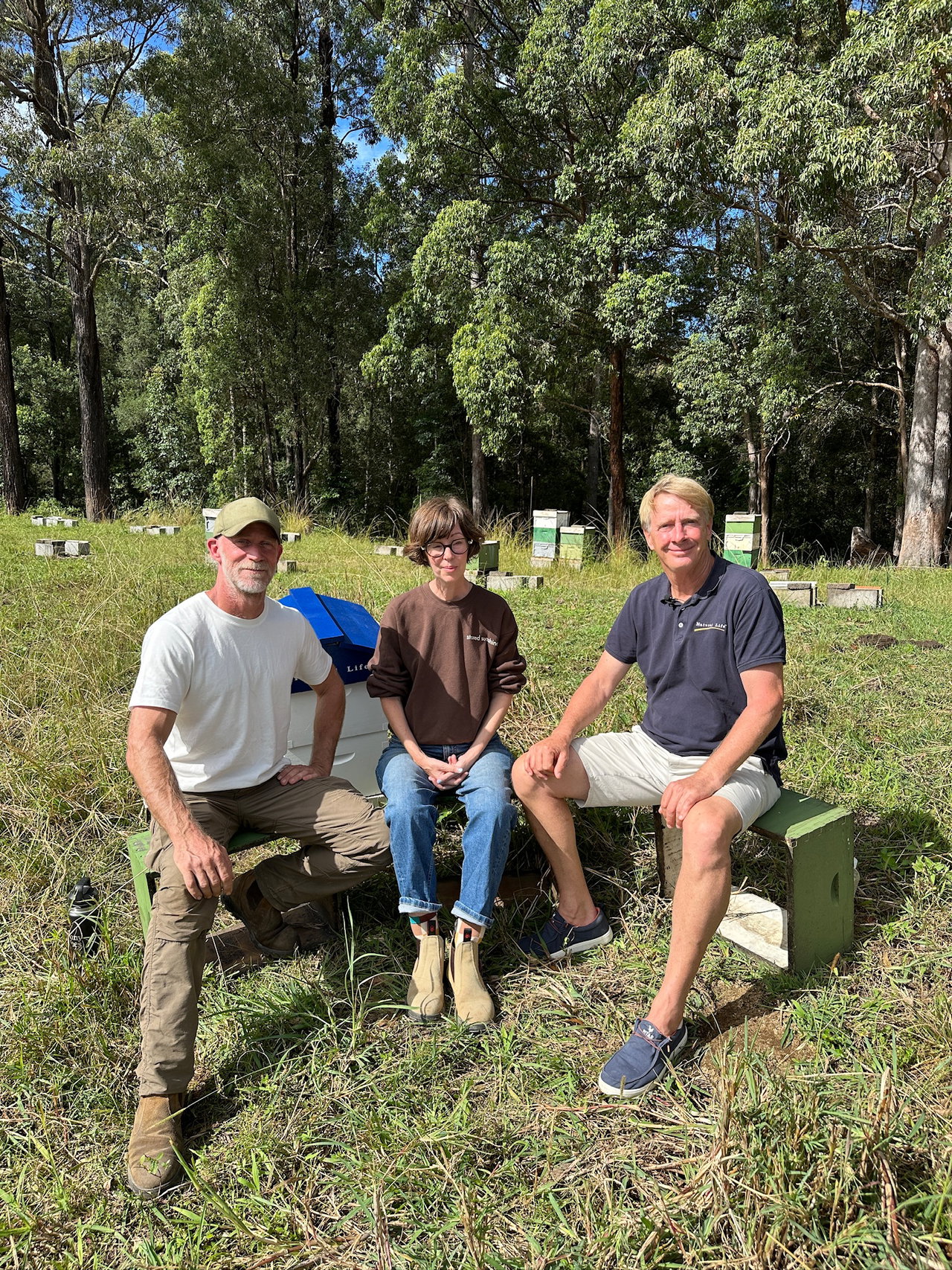
Aidan and Mishy, the husband-and-wife team behind Sunny Times Honey, are beekeepers from the Tweed Valley with a deep respect for bees, land and the seasons. Their honey is raw, seasonal and shaped by the landscape around them - a snapshot of the flowers, weather and ecology of that moment in time.
Listen via the links below.


Around The Hive Podcast
ALL THINGS BEES
Sign up to our newsletter below to never miss an episode. Don't be shy, we don't sting.
Episode 3: Sunny Times Honey
“Real honey naturally changes with the season. One release might carry ironbark, another might taste completely different - every jar captures what was happening in the hive at that exact moment.”
Sunny Times
Watch the podcast below, or scroll down to read the full interview. Sign up to our newsletter here.

Full Interview
Hi guys, here we are, Anthony, Natural Life, Around the Hive with two great people, beekeepers up in the Tweed Valley. We've got Aidan and Mishy, husband and wife, beekeepers for the past 15 years. We're here to hear their story.
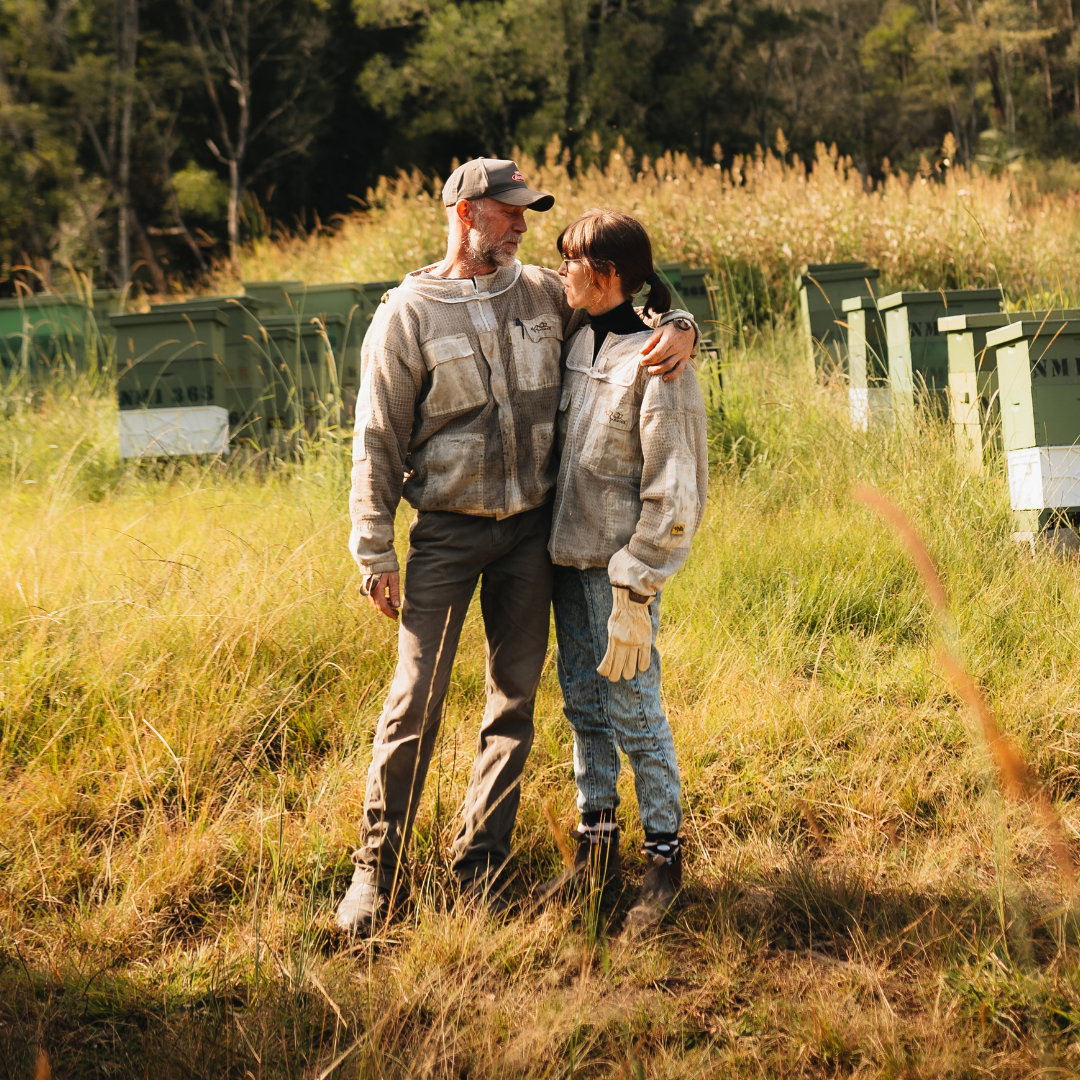
Hi, yes, we are the founders of Sunny Times Honey. We're a bee-led apiary up here in northern New South Wales, this beautiful spot in the Tweed Valley. And we make a honey that is really like stored sunshine. Each jar is almost like a snapshot of the landscape and the season, and it can never be repeated. So it's really like that's what real honey is.
Right. So just winding back a little bit, your backstory, you've been here for 15 years, you've moved up from Melbourne, you settled here, found a bush block. Why did you come up here?
Yeah, it was a bit of a wild spot, kind of untamed, and we found it just by chance. So we decided to move to an area that was just greener. We were looking for more space and probably a quieter life. And we started doing regenerative agriculture and then almost ran out of space in our little pocket of forest. And then came the bees.
So Aidan, why regenerative farming and then why bees?
Fifteen years later, well we actually stumbled into beekeeping by accident. It was a buddy of ours that had bees, wanted to bring them out. He had some queens he wanted to mate on our property with the local sort of feral bees. His circumstances changed, so he asked us, do we want the bees? We popped them open, I had no idea what we were doing, and I was just hooked. Instantly hooked. There was just something about them that was fascinating and I needed to know more. So five hives turned to 20, turned to 50, 100, 250.
Wow, so now it's mainly honey as opposed to regenerative farming? Are you still doing both?
Yeah, no, we backed off on it. It was just way more interesting. The bees were way more interesting than growing ginger and turmeric and things like that in between the cover crops. It just turned out to be the best use of that land as far as agriculture. It used to be an old banana block years ago that was left, and we just thought, surrounded by forests, bordering on two national parks, bees were the perfect mix as far as land use. And we just went from there.
Yeah, so did you have an understanding of bees and farming at the time, pollination and the importance of bees?
We'd worked on a few farms in the valley before, but bees, no idea. It was a very steep learning curve, which I think is part of the challenge. Quite quickly you realise you're not in control and you are dealing with systems that are much, much larger than you. I think that's part of the fun.
So you've got four different areas in the Tweed Valley that you have your hives?
We stay specifically within the Tweed Valley here. It's an old volcanic crater, a caldera. The walls go off about a kilometre around each side. You can see over there. Absolutely beautiful. So we tend not to leave the valley as far as the bees go
. About four to five yards dotted around the valley. One over here, one back there, two over that way, this one and one over there.
So, Aidan, you were talking about lots of beekeepers move the hives around following the pollination, but you don't do that. Your hives are stationary hives. So you have four lots with different hives in each? 100 hives in each?
Yeah, we've got about 30 to 40 hives per yard and about five to six yards dotted around the valley, specifically staying in the valley. We don't want to move our hives. I get that guys need to chase production, continuous flow, pollination contracts. Those guys are doing a great job out there. It takes a lot of skill and knowledge to keep your bees on flow and know when to move them and work with landholders and growers.
But for us, it's more about local genetics. It's more about keeping our bees here. It's more about plugging in and keeping them in rhythm with this local ecology, this landscape, and tasting what this area tastes like as far as how the bees work it. It's just much more important for us to do that.
We like to keep them close to home. All of our yards are on friends' properties or neighbours' properties. They all back onto national parks and they're all within 10 minutes of our house, so it just makes a really nice, easier workflow.
Yeah, wonderful. And does that help with the organic certification, which you don't promote? Because I understand bees fly seven kilometre diameter, so there could be farmers all around the area using pesticides. It's really difficult to get organic certification. But because we're so remote here, I guess that's why you're able to get organic certification. Do you want to answer that one?
Yeah, we have two of our yards that are certified organic. And it was really important to us because it gives customers that reassurance that yes, we're doing all of the right things. We're doing the right things by the ecology, by the soil and the land, and definitely by the bees and the bees' health. Therefore, whatever you eat, you know that nothing chemical or nasty has gone into it.
We are definitely remote. So the two spots that we have certified, the bees travel up to seven kilometres from that spot, but there's no industrial, commercial, really big agriculture nearby. So they really have this amazing access to freedom and purity. We don't promote it as such, but it does give people that reassurance.
Yeah, wonderful, because there's not many people, because of the nature of honey and the way bees fly, there's not many honeys out there that are organic or certified.
Yeah, it's really hard. We're only one of a couple in Australia.
Wonderful. Great. We're obviously in a pretty volatile ecosystem up here. How does the weather play into beekeeping?
Weather's always a factor. You're always working with it, fighting it, trying to predict it, managing around it. The last two weeks were just nothing but rain and I was waiting on queens to be mated. It was somewhat of a disaster. It was a depressing week, but that's part of the game.
The good thing is that just not moving, keeping our hives stationary, you become attuned to it. You know when you can do things and what to expect. You know seasonal indicators that you can constantly pick up as you drive between yards, and you go, this is what's happening, so that means this comes next.
Having said that, there's trees behind me that are flowering that didn't do that last year, so you're always on the fly trying to figure out and decipher what is happening. As the season changes, you can see it rolling from the north coming down the south from the coast, and you know what's coming next as it washes inland. Same with the elevation — these ranges go up a kilometre and you can see it change as you go up.
It's perfect for the bees too. It's almost the perfect spot because you've got yards down the bottom, they fly out in the morning light and they just load up. You can see them in the afternoon just dropping down heavy, full of nectar, full of pollen. They almost prefer to go up versus going down.
So it's kind of subtropical up here, isn't it? So you get lots of rain.
Yeah, we get a lot of rain and we get lots of beautiful sun in between. Those changes in the season are represented in each jar, so that seasonal change is reflected. Sometimes when it's really hot and you get a really good flush of ironbark, the bee's recipe of honey might be really strong in ironbark but just with a little touch of bloodwood. Then the next season it could be completely different. So it's a real snapshot of each season and as it changes through the year.
Yeah, wow, so you've become the real connoisseurs of honey.
Yeah, it's kind of like a wine vintage. Each seasonal release is different.
So can you smell it as opposed to tasting it too?
Oh yes, yeah. And you can see it too. We try not to do single origin. It's a real, I don't want to say blend, but we take it off as they put it on. We have such a short window to catch the flow for the bees. The biodiversity is just through the roof, so you have multiple species all flowering at once and you can see it on the frames as they bring it in.
Each year that changes. Like Mish said, it might be 70 this, 30 that, and each year each tree changes how heavy they flower or if they back off. Some years they're all on, some years some don't do it. It's incredible.
So when you label Sunny Times, do you label it different flavours?
No, we just label it as raw honey. It just naturally changes. Each seasonal release is different and it's never to be repeated. It's incredible. When you really think about what they do, it's just an incredible moment in time captured — this snapshot of what was happening based on weather patterns, previous rainfall, drought, the topography here, the gullies, the ridges. That gets reflected in the honey and it never seems to make me tired. It always changes and it's always so good.
To work somewhere like when you're extracting and the smell of the honey, it's intoxicating. It's so fun and it's so moreish.
So I've got the creamed honey here, which is one of my personal favourites. I'm going to steal this one after. How do you actually make creamed honey? Do you want to talk about the process?
Sure. What we do is raw honey, and creamed honey is sort of an extension of that. All raw honey will crystallise naturally. That's how you know it's raw. So we steer or guide that process by cooling it. We never heat our honey. On the other side, we cool it to basically start that process and we constantly move or spin the raw honey.
As it cools, it starts to form crystals. Eventually, if you've got a good seed stock, it starts to crystallise and form this nice, silky, creamy, velvety, beautiful, delicious honey.
I remember when I was a kid, creamed honey, and so many people go, I remember this. It's nice to bring it back and share that experience with our kids and everybody else's kids.
So just on the starter, it's a bit like a yeast in bread. What is the starter and how do you use it?
It is starting with a honey that will crystallise easily but also has very fine grain crystals, small crystals. I guess like a snowflake, it repeats. Once you add more honey, it keeps growing.
We specifically put a couple of hives down on clover and took the honey from that. It started to seed. Clover honey crystallises quite quickly and quite fine. We started the seed with that and it's been, I don't know how many batches we've done, but from that original starter, we just top it up and go again.
. I love when it looks really, really white. It just looks really clean and pure and it's so silky. It's a completely different experience than runny honey. No twisting of the knife or anything. It's just a clean spread.
So besides the creamed honey, what other honeys do you have in your range?
We do raw honey, creamed honey and honeycomb, which is pure honeycomb cut straight out of the hive, just as it is. We don't add anything to any of our honeys. We don't take anything away. We just want to really showcase the beauty of honey as it used to be. Honey to plate. Something really simple, honouring how honey used to be.
It's a little bit different nowadays. You don't want to go into imported honey, but there's a huge market out there and it's nice to keep it simple and let people rest assured that it's the real deal.
For people that don't know about the varroa mite, why is it such a big deal in the industry?
Varroa mite is the biggest threat to beekeeping globally. It's Australia's turn now. We're sort of the last place that didn't have it, that has it now. Actually, a year ago today we found it in our hives and it's changed everything. The game is the same, but the rules have changed. It can take down colonies if you're not actively in there.
In the end, it's going to cause us all to be better beekeepers because we're in our hives more often and paying attention. It's been a challenge. We made a decision early on when it arrived in the country to not use the synthetic miticides. Knowing that we made that decision, we knew we would lose colonies.
We looked overseas, knowing that there was a lot of information over there that the tip of the spear is all in genetics.
We had about 250 colonies going into this. We've probably lost over a third of our colonies to varroa and hive beetle. It's been a really, really hard year.
We could drop the chemicals and just keep rolling, and I get that people are doing that, but in a weird way this has become more interesting now. If anybody knows anything about the genetics of bees, it's just fascinating. Now's our chance to really dig in. I think every beekeeper has a role to play now in selecting bees that are actually actively pushing back against it.
So tell me, I've been a beekeeper myself and I've watched them travel, migrate from Queensland down to New South Wales. They've affected my hives and now I understand that they're touching on Victoria and moving over into South Australia as well. But what actually is the varroa mite? Just explain what varroa mite is and what it does to the colony.
It's a parasitic mite, like a tick, that feeds on the bees inside at the pupal stage and also on the adult bee outside. It weakens the bees. It feeds on their fat bodies. Long term, it's the viral load. Even though in Australia we're told that we don't have the viruses yet, once we do, then we will really start to see some colony losses. It's the viral load that eventually brings colonies down quite quickly.
There is no real cure. Once you have them, you have them. You can never really get rid of them. But for us, it's not really about having zero mites. It's about a balance throughout the population. I'm finding bees that will deal with it.
So you talk about genetics. How does genetics play into it? How can you actually breed in or breed out the genetics?
I have to be honest, it's a process. There's no super bee. People smarter than I have been working on this for longer than any of us in this country. We have a simple approach. We do an alcohol wash or a soapy water wash every month, every hive, every month. We watch the trends, and even within our population, there are bees that are keeping it down.
We still treat with the organic acids, oxalic acid, and then it's all mechanical brood breaks, knowing when to interrupt, removing queens, requeening, splits. Even then, we lost a third or so of our operation. Standing here today, we're back as far as what we lost. We've made it back, and those queens are from ones that we've selected based on the washes that we've had. So about 12 months worth of washes and you can see ones that are actively keeping it down. We just start that process, start picking the winners. They're out there.
So she becomes a stronger bee laying stronger eggs, better genetics, so you've got better genetics in the hive to actually fight or repel the virus?
Exactly. It's early days. It's really early days. We may as well start that process.
And how long has it been in America for?
If anything, it seems to have gotten worse, mainly because the two or three main synthetic chemicals that they're using, varroa mite seems to now have resistance against those chemicals. We just recently found out in Australia there's been a second incursion of varroa mite, meaning it's come into the country twice. Mites that have come in have resistance to the main chemicals that some beekeepers are relying on. So it's even more reason just to, you can hop on the treadmill or you can hop straight to genetics, and that is the future really.
So this has affected you guys personally. It's affected beekeepers all throughout Queensland, New South Wales, now Victoria. How does that affect the person on the street? Why are bees so important to us? And how is this so devastating to the industry?
It's devastating to us. Day to day, you come back and you've lost all of these hives. It's not even just the loss of the bees, but it's also the loss of that potential and the loss of all the work that you've done setting them up to a certain stage. It's a pretty hard time for beekeepers at the moment, but we are really committed to not using synthetic chemicals and taking that longer approach. There's less yield, but it's a longer-term game, so it's harder and more expensive.
The bees pollinate 65% of the crops around Australia, so without the bees we don't have food and so on and so forth. Einstein said three years later we're all starving. So this could be a really serious thing for the industry and the world.
Yeah, absolutely. I think instantly it'll show up in food prices and things that rely on pollination. Locally, you can hear people even in the town here say they haven't seen a bee for a while. The feral, wild or free-living populations have pretty much crashed, so it's going to take a few years for that to rebound. It's absolutely devastating.
We're new into beekeeping. This is probably about year seven, but really, we're in it and then this shows up. I think that is a benefit in one way because we're not following tradition from past generations. We're learning everything that we can from the people that have been doing it for a long time. Really, the tip of the edge in America, what's working and what's not, and we're laying that on this climate and trying our best to stay the course and protect what we've got, but also doing the right thing.
There are a lot of things to our advantage here by not moving our hives. We don't have that increased chemical load that you might get in agricultural settings. It doesn't stress out the bees. You've got a little bit of local adaptation. You're interbreeding with what's left of the wild colonies. And through selection, observation, monitoring, you may just be able to win. Eventually, 20 years from now.
So for the listeners, if someone's out there that wants to get into beekeeping, what's the best way to do it and why should they do it?
I think of a million reasons why they should. It's just the best. It really is. I think if they're interested, just find a beekeeper, give them a hug, and buy their honey. Just get started. Just jump in. It's not scary. It's really exciting. I've met so many people that when you say you're a beekeeper, they just light up. I've never not had somebody go, oh my God. It's just a rewarding experience when you say that you're a beekeeper. It really does feel like you're giving something back, and honey is just part of it. If you were ever thinking about bees, just jump in.
You can also listen to the podcast on Spotify below.
Watch the podcast below, or scroll down to read the full interview. Sign up to our newsletter here.
Episode 3: Sunny Times Honey
For our second episode of Around The Hive, we sat down with the legend Clancy Lester to talk about his personal journey to becoming an environemental educator. Scroll down below to listen to the podcast.
Sign up to our newsletter below to never miss an episode. Don't be shy, we don't sting.
“Real honey naturally changes with the season. One release might carry ironbark, another might taste completely different - every jar captures what was happening in the hive at that exact moment.”
Sunny Times
Follow us on all platforms.