Inspiring The Next Generation Of Aussies
Clancy Lester, aka Bees & Blossoms, is an everyday Aussie with an unbeatable passion for bees, native plants and nature. To us, he’s the Steve Irwin of bees. Curious, full of energy and on a mission to help more Aussies care about the guys that keep nature ticking. Listen via the links below.


Around The Hive Podcast
ALL THINGS BEES
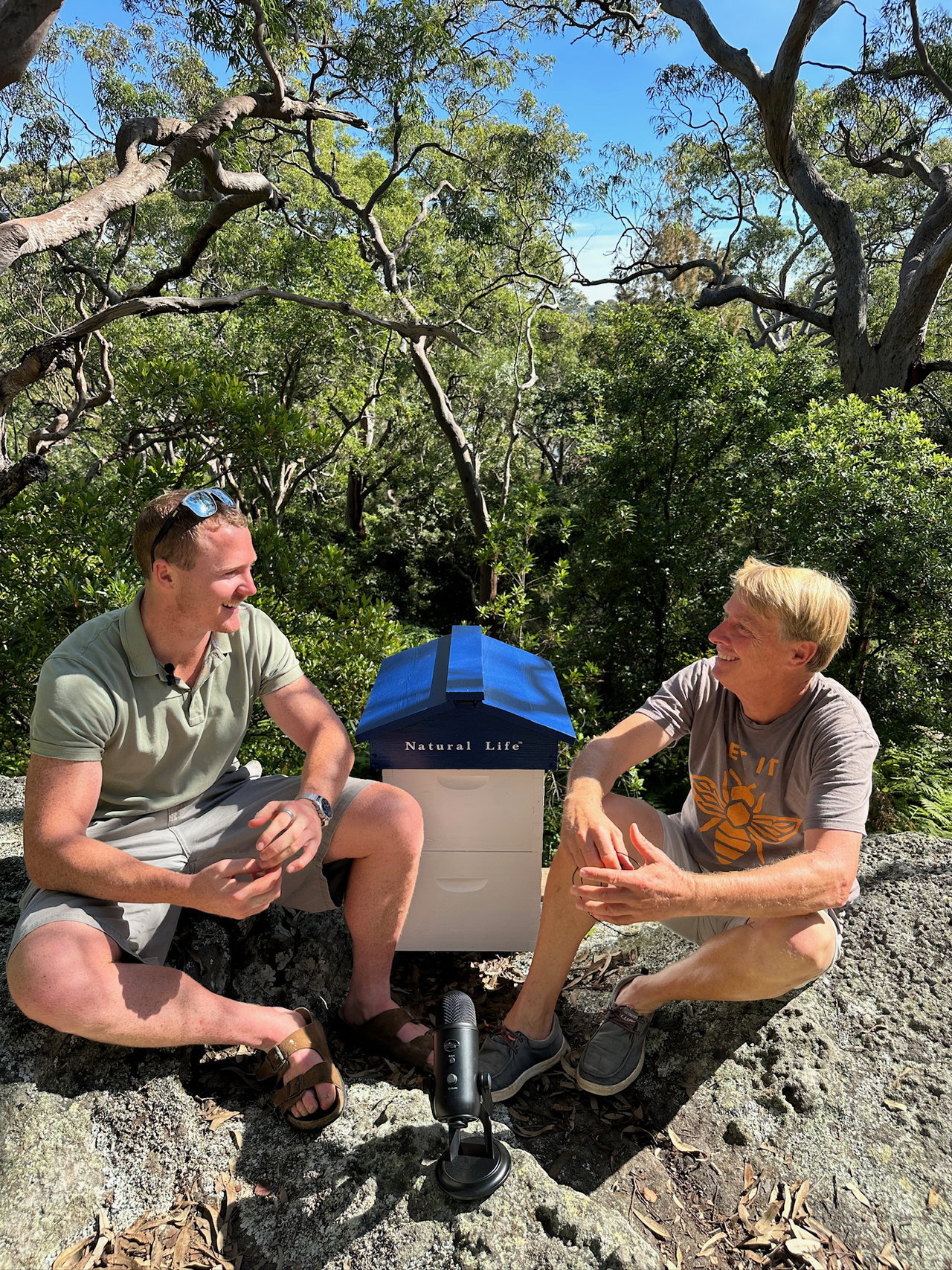
For our second episode of Around The Hive, we sat down with the legend Clancy Lester to talk about his personal journey to becoming an environemental educator. Scroll down below to listen to the podcast.
Sign up to our newsletter below to never miss an episode. Don't be shy, we don't sting.
Episode 2: Clancy Lester
“Like, there's no point in having that [bare nature strips] only for me to be able to be a nuisance in public in my budgie smugglers.”
Clancy Lester
Watch the podcast below, or scroll down to read the full interview. Sign up to our newsletter here.

Full Interview
For people meeting you for the first time, how do bees become an important part of your life and how did you become the bee man?

So for people meeting me for the first time, I'm just an everyday Aussie. I grew up in the country just loving nature and the environment,Steve Irwin, that sort of stuff, watching those nature documentaries. And so I've always loved, you know, insects, all different sorts of animals and plants. And it was more recently when I got to do a research project in northeast Arnhem Land, which was learning about native bees and the culture and the significance and how important they are in Arnhem Land with the Yongnu people and that was just super super special and I just developed a whole another connection to bees and having an appreciation for it and then learning about you know how they're declining and facing all sorts of threats and things wanting to look after and care for it and then that's where I found you know social media and science communication and talking to people about how awesome they are and what we can do to look after them.
Yeah, wow. Unreal. So what have bees taught you? Not just about nature, but how we live and relate to the world.
Just the fact that they're such an important part of such a well-oiled machine of nature, like these ecosystems where they're so important, you know, to our food systems and to... just all of the plant life and the flowers, the fruits, the berries, all the sorts of things we see in these ecosystems. And, you know, like just outside the frame, we were looking at a specialist type of bee, which its whole life and all of its behavioural adaptions, its structural adaptions is to specialise, to pollinate. The g-bung or the persoonia and you've seen that had that the the hairless face and the strong neck that it uses to open the open the the g-bung flower and then scrape out the pollen and just just that to the fact that these such specialised and important parts of a little ecosystem. It's super special to me when you think about we're all part of it, part of the ecosystem, part of nature ourselves.
Yeah, right. So like European bees, native bees are great pollinators too?
Yeah, absolutely. So, yeah, European bees, they're great pollinators of pretty much anything. They're what we call super generalist because they'll just pollinate just about any native plant or any exotic plant, any flower pretty much that you put in front of them. They'll have a crack at pollinating it. And native bees, some of them are slightly the same. So some of the stingless bees like the native eusocial bees that are also pretty a bit more generalist. Blue banded bees as well. That's why a lot of people see blue banded bees in their garden, regardless if they have natives or if they have lavender or salvia as well but yeah we do have native specialist bees like that are specifically adapted to maybe a family of of flowering plants or even a genus or even a species if they're super super specialist, they're like fussy eaters.
Yeah right so they just they're more local?
yeah absolutely so that they might uh their their ranges might overlap with where that particular species that they love to pollinate will also be around okay so so great for urban environments cities suburbs in sydney you know i guess you've got specific uh native bees for each area depending on where the flowers are flowering and that's that's when that when we say like build it and they'll come or plant it and they'll come you know if you want to have a biodiversity in your garden you should have a diversity in the plants because you have more different plants then you might encourage more of those more fussy eaters that might not you know want lavenders or might not want roses or they might want specific indigenous plants to your area or like just a bit more of a diversity in your planting okay and if you do encourage different species of native bees to come into your garden
Do they all get on?
Yeah, absolutely. So depending on the species as well, because sometimes there is a bit of competition between, say, like within species of the Tetragonula carbonaria, one of the stingless bee species can have biffs between hives. And sometimes if there's a lack of or like not as many resources to go around, the honeybees are pretty good and they might compete with natives as well. You want a diversity of bees in your garden because if you have a flower that gets 10 visits, and there's science to support this, if you have a flower that gets 10 visits, if those 10 visits are from 10 different species, the pollination will be more efficient and more effective than if... the pollination was done by 10 visits of the same species. Because if you think about the different time of day they're active, the different sizes of the bees, the different structures on their scoper or the way they collect the pollen and all these different things might have slightly different interactions that will further benefit the pollination.
Yeah, wow, cool. Just getting back to you, 2025 was a huge year for you. 123 workshops, nine conferences, thousands of bee hotels, media, plus lots of behind the scenes with the work you do with the politicians. When you look back on the year, what stands out for you most?
Oh, I reckon one thing that I really just love and appreciate is the fact that when I talk about, you know, how awesome native bees are or like... and planting native plants the fact that when people will send me a photo of the garden that they've just planted like look at all these plants I've planted or look at this bee hotel I made like when I've seen the real world impact of like inspiring people to get involved and do what they can to look after the environment that's really what stands out to me and those sort of like messages of support and the community that is behind you know wanting to better the environment has been super special.
And the politicians how receptive are they to change and you getting in there?
Yeah, absolutely. I'm definitely not afraid to be vocal and to advocate for what's best for nature, what's best for us as society. It's funny with the people making the decisions because they're wanting to be representative of their employee to represent us and be representative. But at times they might be representative of the people that are tapping them on the shoulder or that are in the rooms with them, which is quite often old white men. So I love to have the chance to talk with and meet with these people in charge of the decisions. And at times we see eye to eye and there is good ones out there that do care for the environment and nature, such as David Pocock. And then sometimes there's others that you might need to put a bit of a spin on it to make the cogs turn in their brain. Hang on, that might get me votes, that might get me public support. So there's sort of different ways to attack it. But any way that I can advocate and get around nature, I do try my best, absolutely.
And is there a particular cause you're pushing? Obviously nature in general, but is there something specific you want to get over the line?
There's been a few that I've been a part of that one of the recent ones has been around nature strips and how you know a lot of our gardens or you know roadside verges are grass and just is not a very biodiverse area it's not really conductive or supportive of biodiversity and nature and has so much potential if we're replacing that with native flowers and that's something that's quite often your local council is in charge of and so you know encouraging people to email their councillors to speak at meetings to sort of push different policy change or motions at meetings has been like a really awesome sort of wave of momentum around you know a little thing that people can get involved in in their community to encourage biodiversity has also been things around the the second generation anticoagulant rodenticides or rat sacks that people can buy off their shelf and put in their backyard or their house to kill rats and rodents. This quite often just slows them down for a few days and leaves them vulnerable to birds of prey like owls and eagles and also like snakes and all different types of animals that are eating these rats and then also dying. And we've gotten just recently through petitions and advocacy that's been banned off the shelves of Bunnings in different places. So there is some really awesome examples of wins that we're having in nature when communities come together and advocate for change.
Yeah, wonderful. doing incredible work. So, what's the council's view is it a federal view or is it a council view so if you do want a nature strip in front of your house because you don't you know we're here in Balgowlah the suburb of sydney I walk around here with my dog pretty much every day i don't see any nature strip any gardens or nature strips at the front is that is that because people don't think about doing it or is it because the council won't allow it?
Yeah it can be a mix of those things because even sometimes if people do want to put plants and native flowers in their nature trips, sometimes it is up to the guidelines and the laws of your local council and what they allow or what they encourage. And that's why sometimes it's just been something that's never been thought of or looked at. And if it gets brought up in the meeting, the council's going to think, oh, that's a great idea. It's going to save us money on the contracts that we spend mowing and maintaining these and watering these, especially when you think about droughts and the price of fuel for this machinery. It's going to be a win-win if you've got local people within the community doing free work, converting these lawns into biodiverse things that are encouraged, nature, and they're going to be better to look at for our mental health, better for shade, all these sorts of things that we can really, it's like a massive win-win when you think about it.
So are there any negatives to having a garden on your nature strip?
Yeah well i wouldn't say negatives but there's things to consider and things like you know the accessibility for people walking prams and wheelchairs and things or also the sight line of cars and and there is certain things that people that people bring up and that's quite often what is actually included in these guidelines that they make sure pretty pretty easily managed.
Yeah absolutely yeah yeah cool okay so you've mentioned there could be two and a half thousand native bees in australia yet most eyes you just think about the honeybee the european bee. Why are native bees so unique and important to Australian ecosystems? And do you have a personal favourite?
The G-bung bee. Yeah, yeah. I think that's probably my favourite today because I've been over the moon to see that. But there is such an incredible diversity of native bees in Australia. One of the reasons for this is the fact that people forget that Australia is an island. We've been isolated from the rest of the world for millions of years. And when you have this isolation, you have native plants and native bees that have been disconnected from the rest of the world for millions of years. And so over time, you have these... particular species that emerge like we have the diversity of eucalyptus in Australia is absolutely insane and like I think it's over 800 species same with acacia same with our daisies like over in Perth all the wildflowers and when you have a diversity in an isolated area and you have all of these interactions between the flowers and the pollinators that look after them you have such an awesome mixture of the diversity of bees that have specialised to our local environments and climates. And that's why I encourage people to plant native plants, particularly ones that are indigenous to your area. Because over these millions of years, you have these adaptions that when a native bee is put in front of a rose or a hedge or... a lavender or a salvia, some things that are typically in our, you know, standard Aussie backyard cottage garden. And native bees are going to go, what on earth is this? I've not seen this in my millions of years in Australia. And they're adapted to native species that are more localised to our climate and our environment. So that's why native bees will typically prefer native plants and why I encourage that.
Will they still pollinate introduced plants?
Well, it depends how specialised they are. So if they're a little bit more generalist and they're happy to, they're not as fussy eaters or they're not as specialised to a particular plant, they might venture across genera and families and pollinate the introduced species and exotic species. And that's why people quite often see that blue banded bee in their garden because they're a bit more generalist.
So, honey aside, do we need European bees?
Obviously for the introduced plant. they pollinate the introduced plants. But that aside also, do we need European bees? Or could we do without them?
Well, this is an interesting one because they've been in Australia for over 200 years. I think it was around 1820 or so that they were actually introduced to Australia, mainly for the purpose of pollinating the European crops and fruits and berries that native bees weren't really interested in and were failing. So they brought in the European bees, which are much more effective pollinators for crops and particularly... There's services that we get from the European bees that will never be able to be achieved by native bees. When you think about, you know, like the apple pollination, when they just get millions and millions of bees to come in over a short period of time and just go absolutely nuts. This is not something that we'll ever be able to fill the void with native bees. But in our natural environments, like in our bushland, this is where we've had millions of years of evolution without European bees that if they weren't... are active in that environment, the native bees would be able to fill that void again and coincide. But yeah, it's more encouraging of responsible beekeeping when beekeepers have their bees on their local block and they're stopping them from swarming. It's when the European bees are reaching the tree hollows in the bush where they're kicking out the native birds and possums and things or when they're competing for resources. remnant bushland is when I would rather be native bees. But they obviously have their place in Australia with our crops and with our awesome honey production that they can produce like a hundred times as much in a calendar year.
So what I like about your story is your work with the First Nation people up in the Northern Territory. So you've got a bit of a story about that. So you've worked closely with the First Nation people and their knowledge systems. What's something from your experience that fundamentally changed how you see the land the conservation and responsibility i guess through their eyes?
Yeah absolutely one thing that was just super special to me was just the the connection to country and seeing yourself as a part of nature itself you know - we've grown up in this society where you know where we're becoming more disconnected from nature especially living in boxes in houses we're in spend our time in offices we're in cities and we're not seeing ourselves as a part of nature ourselves and we're disconnected from that we're disconnected from each other and through an indigenous lens and seeing yourself as a part of your local environment and this holistic way of thinking like not. You know, when we talk about the time of year, we say, you know, summer, autumn, winter, spring, and that stops, summer stops on the 28th of February and then the 1st of March we're in autumn.
Whereas in Indigenous ways of thinking, it's when the cooler weather approaches, when the first summer rains, when the birds, when particular bird species come to nest, when... different things are happening around our environment and it's more of a continual thing rather than these these boxes and these these borders and and like real black and white sort of things that we we try and come up with
and that's one thing that just yeah seeing myself as as a part of everything has helped me connect and more appreciate it more
so we've got four seasons and they’ve got seven? Well, depending on where you are. More of a flow.
Yeah, yeah, because we have hundreds of language groups all around Australia. So where I've grown up with in country Victoria, there's different seasons as to where I live now in Melbourne as to different seasons that we have here in Melbourne. I think we're on Gadigal country here. It’s because it's so specific because every... Indigenous country has different bird species, has different local climate, has different weather patterns, different trees are flowering. There's all these different things which are part of our local environments to take notice of that doesn't really spread right across Australia.
Yeah, right. Wow. We're a big fan of your Buzz of Hope series on Instagram. Beyond Awareness, what do you personally have to inspire through your work, both online and out in the world?
Yeah, so I do love the buzz of hope and positive messaging and finding ways to bring people together because we're well aware, anyone that's up to date with the research or the sort of state of the world, we're aware of what's coming with the climate crisis and these sorts of things that are in store for the future. Being all doom and gloom won't ever get us anywhere and so we do need to find ways to be positive and be optimistic and have hope about certain things so that we can continue to act on things because obviously the best time to act on things around the climate and do what we can to look after nature was, you know, 50 years ago, 100 years ago, whenever we sort of started going downhill as a society. But the second best time to act and do what we can is today and to really think about what we can do for not only ourselves and for our kids but, you know, future generations to come. And it's like the age-old tale of the person who plants the tree for the shade that he knows he won't get to enjoy but, you know, someone down the line will. And, you know, finding the positive ways for people to just... you know be able to connect with nature and appreciate nature so that they can care for it um is what i love to really enjoy doing
Yeah mate that's unreal so you're spreading the message through the buzz of hope in in instagram but you also do these incursions in schools and workshops for corporates as well must be pretty inspiring seeing little kids sort of yeah being part of your world yeah big kid being trying to inspire little kids you must get a lot from that
yeah absolutely and i love the fact that when you have like you talk about so I like to start off with it with a talk and get into know kids and just a bit of bit of a like an intro a bit of a taster about native bees or flowers or something and then i love to have a practical component like where we're going outside on a little a bush walk or making bee hotels or planting native plants and when you see kids like they go from sitting inside the classroom twiddling their thumbs to to like looking inside a flower and seeing a pollinator and or like when when you really see it clicking in their brain that it's like really cool to be out um and connecting with nature that's just yeah super special yeah
And what about the corporates you know the older people?
That's a funny one because I've actually had a few corporate events because you sort of expect it to be like the local gardeners and the land care groups and the people, the ranges that really love being out in nature to be the most interested. But at times it's being the corporate people because they're stuck inside this office. They get the opportunity to learn about nature and get out amongst it. They're just absolutely fascinated and then hopefully inspired to continue doing it. Because like I was saying before, any opportunity I get to advocate for nature to inspire people, I jump at it. And I surprisingly really enjoyed the corporate side of things and connecting with people that might not be... traditionally associated with with being in nature. yeah unreal that's awesome i think we all like nature we're all just sort of pigeonholed into cubicles in city buildings and we get stuck so we just earn for that freedom and this yeah you can't beat this fixing it's just yeah leveling yeah leveling grounding within the series
What's the biggest buzz of hope for our native bees over the past year ?
That's a great question there's a few things that come to mind I feel like the fact that we're still finding new species, that currently we have 1,719, or they're about species that we actually just have names for. And we still have hundreds of species that are out there still yet to be discovered. And so recently, a famous or well-known native bee researcher, Kit Prendergast, found a new species that has these growths that look likehorns on either side of its cliopaeus on its face. And she even named it... kylie lucifer after the
devil um and so i thought that that was like one of those things where people from far and wide were like that is awesome like this this is such a unique cool interesting native bee and that was one of those things that really breaks through those you know instead of preaching to the converted it really broke through to every everyday aussies and everyday people around the world to go that is really awesome about native bees and that we have european honeybees getting past that and that there's there's just all these intricate charismatic species out there as well yes i know
I think that's amazing that um so this lady that's discovered the the devil bee um lucifer she must know 1700 species she must have for to identify this as a new one she must know 1700 species, which is pretty incredible.
If there was anyone out there that knew all of the native bee species in Australia, I reckon it would be Kit Prendergast. She's an absolute bee nerd. She loves it. She's a well and truly just absolute legend of the native bee industry. And what I found really interesting when I was doing my research on native bees, there's a few that are like, you know, some are blue, some are yellow, some have different hair in different places. But when you're talking about in terms of thousands of bees, there might be a few hundred species that are small and black. And to tell them apart, whether the vein on their wing is curved or if it's more straight or the amount of hair on... the the top of their head or like the length of the spurs on their kneecaps like the smallest little details will distinguish between bee species and I had a newfound love for taxonomists that nerd out on this sort of stuff because i just was in disbelief how complex it can be wow that too such a detail yeah it's crazy
Okay if every listener could make one small change to help protect pollinators what would you recommend it be?
oh I reckon There's a few different things that people can do and they're all pretty straightforward. There's, I would say, probably three main things you can do. The first one being you don't need to spray as much pesticide and insecticides in your garden. Quite often I'll say it's not usually a pest problem, it's usually a biodiverse problem because if you have aphids on your roses... There's natural predators of aphids, whether it's ladybug larvae, whether it's lacewings or whether it's parasitic wasps. There's lots of natural predators of the pests that we have in our gardens that are what encourage people to use the pesticides in the first place. So finding ways to have biodiversity in your garden instead of using pesticides as one. Planting native indigenous plants to your local area, I think is probably the best one. Having more species, more diversity, more habitat, more flowers in your garden, more resources, more places for bees and insects and wildlife to have as a home and for food and resources is probably the best thing you can do. And it's easy to go to your local native nursery and buy the plants, put them in the ground. And lastly, making bee hotels like drilling holes into hardwood logs, leaving bare patches of clay and soil and getting bundles of hollow and pithy stems for habitat.
So you're talking about suburban houses that have it back out in the front yard and the gardens. What about people that live in high-rise in the city or apartment blocks? How can they contribute to helping out the native bee population?
Yeah, so even on balconies and in these apartment buildings, I'm not sure what the record is for the highest people have seen butterflies and bees on buildings, but as you know... with your friend from rooftop bees. Bees are more than capable of reaching the tops of our apartment buildings and, you know, having a little patch of wildflowers on your balcony, that can also play its part as well.
So with a bee hotel next to it?
Yeah, absolutely. But yeah, some people that might not have access or the ability to that, you know, you can join a local volunteer group. There's friends of groups, there's local land care groups, there's definitely... ways for people to get involved and help out, contribute to this. And have fun and be social.
Yeah, absolutely. It's all about community, supporting community. So that leads me to the next question. If someone was interested in participating in the workshop, making a nature shoot, bee hotels, where can they actually find out more information on all of this?
Yeah, quite often local councillors do have information about, where to find where your local native nurseries are or the best plants for your area. I also do have my own social media. I'm right across everything, making silly videos and posts on the internet. And my handle is Bees and Blossoms. Bees and Blossoms. And I also have a website, beesandblossoms.org. So yeah, people will be able to find me and watch my videos. I have... DIY videos on how to make bee hotels and the best plants to plant and resources. And so, yeah, people can feel free to reach out, email me, send me a message. And, yeah, even if you can... try and have a crack at getting me into your local school or council, and I'll be happy to oblige.
I love you. You're unreal. You're like Steve Irwin of Bees and Insects and Everything Nerdy. And I've been watching you on Instagram for the last couple of years, and I love your website. Really entertaining.
My funniest one, or your funniest one, which I believe got millions of hits, was you and... budgie smugglers on a medium strip trying to promote the importance of medium strips. How'd that come down? Why the shock value?
Well, I was thinking about how when you see these nature strips and people are spending all this time mowing, maintaining them, or councils are paying for it, and I was thinking, what is even the point of that? It's a strip of grass in the middle of nowhere. why is that even happening? So I was like, I was going to, I was taking a piss a bit saying like, what am I going to play recreational sports? I was kicking a footy and then I was like, and what am I going to have a picnic? So I had a beer and sat down and then I was like, what am I going to sunbake here? So I got in my budget smugglers and laid down and the news loved that. I had news.com, I had Yahoo, I had radio people that was just saying, you know, like how stupid is this that you're... like sun bacon on your nature strip and your budgie smugglers out in public. And I was going, I know, how stupid is it? Like, why is it a thing? Why is that not native flowers? Like, there's no point in having that for me to be able to be a nuisance in public in my budgie smugglers.
Mate, it was unreal. It was so funny. So go and have a look at Bees and Blossoms, at Bees and Blossoms. Funny. Yeah, cheers. Clancy, I love you. Thank you, unreal. So just to finish, we've got one last question we ask all our guests. What's one fun fact about native bees that you love?
One fun fact. I love the fact that we have cuckoo bees, which are parasitic bees, that everything about their evolution is designed to be parasites of other species like the blue banded bee. And so they look like, for example, the cuckoo bee. that is a parasitic bee of the blue -bounded bee. They look the same. They're active at the same time of year. They like the same plants. They have narrow abdomens, so it's harder for them to get grabbed on the bum and pulled out by the blue-banded bee if they get busted in there. The eggs hatch quicker if they're late at the same time. So it looks like one. Yeah, so they've also got like bright blue as well. Wow. Even, yeah, the eggs will hatch at the same time. And even the very grub of the baby cooker bee will have overdeveloped mandibles or jaws for killing the other grub. So it's just, they're just the ultimate parasite. And I find that so interesting and it's super, such a fun fact for me.
Mate, that's awesome. Unreal. I really love spending time with you here. You're a great guy. Your message to the world is just on cue. It's great. So thanks for spending time with us here today. And keep going. Because we need more men like you. So it's spreading the good word.
You can also listen to the podcast on Spotify below.
Full Interview
For people meeting you for the first time, how do bees become an important part of your life and how did you become the bee man?
So for people meeting me for the first time, I'm just an everyday Aussie. I grew up in the country just loving nature and the environment,Steve Irwin, that sort of stuff, watching those nature documentaries. And so I've always loved, you know, insects, all different sorts of animals and plants. And it was more recently when I got to do a research project in northeast Arnhem Land, which was learning about native bees and the culture and the significance and how important they are in Arnhem Land with the Yongnu people and that was just super super special and I just developed a whole another connection to bees and having an appreciation for it and then learning about you know how they're declining and facing all sorts of threats and things wanting to look after and care for it and then that's where I found you know social media and science communication and talking to people about how awesome they are and what we can do to look after them.
Yeah, wow. Unreal. So what have bees taught you? Not just about nature, but how we live and relate to the world.
Just the fact that they're such an important part of such a well-oiled machine of nature, like these ecosystems where they're so important, you know, to our food systems and to... just all of the plant life and the flowers, the fruits, the berries, all the sorts of things we see in these ecosystems. And, you know, like just outside the frame, we were looking at a specialist type of bee, which its whole life and all of its behavioural adaptions, its structural adaptions is to specialise, to pollinate. The g-bung or the persoonia and you've seen that had that the the hairless face and the strong neck that it uses to open the open the the g-bung flower and then scrape out the pollen and just just that to the fact that these such specialised and important parts of a little ecosystem. It's super special to me when you think about we're all part of it, part of the ecosystem, part of nature ourselves.
Yeah, right. So like European bees, native bees are great pollinators too?
Yeah, absolutely. So, yeah, European bees, they're great pollinators of pretty much anything. They're what we call super generalist because they'll just pollinate just about any native plant or any exotic plant, any flower pretty much that you put in front of them. They'll have a crack at pollinating it. And native bees, some of them are slightly the same. So some of the stingless bees like the native eusocial bees that are also pretty a bit more generalist. Blue banded bees as well. That's why a lot of people see blue banded bees in their garden, regardless if they have natives or if they have lavender or salvia as well but yeah we do have native specialist bees like that are specifically adapted to maybe a family of of flowering plants or even a genus or even a species if they're super super specialist, they're like fussy eaters.
Yeah right so they just they're more local?
yeah absolutely so that they might uh their their ranges might overlap with where that particular species that they love to pollinate will also be around okay so so great for urban environments cities suburbs in sydney you know i guess you've got specific uh native bees for each area depending on where the flowers are flowering and that's that's when that when we say like build it and they'll come or plant it and they'll come you know if you want to have a biodiversity in your garden you should have a diversity in the plants because you have more different plants then you might encourage more of those more fussy eaters that might not you know want lavenders or might not want roses or they might want specific indigenous plants to your area or like just a bit more of a diversity in your planting okay and if you do encourage different species of native bees to come into your garden
Do they all get on?
Yeah, absolutely. So depending on the species as well, because sometimes there is a bit of competition between, say, like within species of the Tetragonula carbonaria, one of the stingless bee species can have biffs between hives. And sometimes if there's a lack of or like not as many resources to go around, the honeybees are pretty good and they might compete with natives as well. You want a diversity of bees in your garden because if you have a flower that gets 10 visits, and there's science to support this, if you have a flower that gets 10 visits, if those 10 visits are from 10 different species, the pollination will be more efficient and more effective than if... the pollination was done by 10 visits of the same species. Because if you think about the different time of day they're active, the different sizes of the bees, the different structures on their scoper or the way they collect the pollen and all these different things might have slightly different interactions that will further benefit the pollination.
Yeah, wow, cool. Just getting back to you, 2025 was a huge year for you. 123 workshops, nine conferences, thousands of bee hotels, media, plus lots of behind the scenes with the work you do with the politicians. When you look back on the year, what stands out for you most?
Oh, I reckon one thing that I really just love and appreciate is the fact that when I talk about, you know, how awesome native bees are or like... and planting native plants the fact that when people will send me a photo of the garden that they've just planted like look at all these plants I've planted or look at this bee hotel I made like when I've seen the real world impact of like inspiring people to get involved and do what they can to look after the environment that's really what stands out to me and those sort of like messages of support and the community that is behind you know wanting to better the environment has been super special.
And the politicians how receptive are they to change and you getting in there?
Yeah, absolutely. I'm definitely not afraid to be vocal and to advocate for what's best for nature, what's best for us as society. It's funny with the people making the decisions because they're wanting to be representative of their employee to represent us and be representative. But at times they might be representative of the people that are tapping them on the shoulder or that are in the rooms with them, which is quite often old white men. So I love to have the chance to talk with and meet with these people in charge of the decisions. And at times we see eye to eye and there is good ones out there that do care for the environment and nature, such as David Pocock. And then sometimes there's others that you might need to put a bit of a spin on it to make the cogs turn in their brain. Hang on, that might get me votes, that might get me public support. So there's sort of different ways to attack it. But any way that I can advocate and get around nature, I do try my best, absolutely.
And is there a particular cause you're pushing? Obviously nature in general, but is there something specific you want to get over the line?
There's been a few that I've been a part of that one of the recent ones has been around nature strips and how you know a lot of our gardens or you know roadside verges are grass and just is not a very biodiverse area it's not really conductive or supportive of biodiversity and nature and has so much potential if we're replacing that with native flowers and that's something that's quite often your local council is in charge of and so you know encouraging people to email their councillors to speak at meetings to sort of push different policy change or motions at meetings has been like a really awesome sort of wave of momentum around you know a little thing that people can get involved in in their community to encourage biodiversity has also been things around the the second generation anticoagulant rodenticides or rat sacks that people can buy off their shelf and put in their backyard or their house to kill rats and rodents. This quite often just slows them down for a few days and leaves them vulnerable to birds of prey like owls and eagles and also like snakes and all different types of animals that are eating these rats and then also dying. And we've gotten just recently through petitions and advocacy that's been banned off the shelves of Bunnings in different places. So there is some really awesome examples of wins that we're having in nature when communities come together and advocate for change.
Yeah, wonderful. doing incredible work. So, what's the council's view is it a federal view or is it a council view so if you do want a nature strip in front of your house because you don't you know we're here in Balgowlah the suburb of sydney I walk around here with my dog pretty much every day i don't see any nature strip any gardens or nature strips at the front is that is that because people don't think about doing it or is it because the council won't allow it?
Yeah it can be a mix of those things because even sometimes if people do want to put plants and native flowers in their nature trips, sometimes it is up to the guidelines and the laws of your local council and what they allow or what they encourage. And that's why sometimes it's just been something that's never been thought of or looked at. And if it gets brought up in the meeting, the council's going to think, oh, that's a great idea. It's going to save us money on the contracts that we spend mowing and maintaining these and watering these, especially when you think about droughts and the price of fuel for this machinery. It's going to be a win-win if you've got local people within the community doing free work, converting these lawns into biodiverse things that are encouraged, nature, and they're going to be better to look at for our mental health, better for shade, all these sorts of things that we can really, it's like a massive win-win when you think about it.
So are there any negatives to having a garden on your nature strip?
Yeah well i wouldn't say negatives but there's things to consider and things like you know the accessibility for people walking prams and wheelchairs and things or also the sight line of cars and and there is certain things that people that people bring up and that's quite often what is actually included in these guidelines that they make sure pretty pretty easily managed.
Yeah absolutely yeah yeah cool okay so you've mentioned there could be two and a half thousand native bees in australia yet most eyes you just think about the honeybee the european bee. Why are native bees so unique and important to Australian ecosystems? And do you have a personal favourite?
The G-bung bee. Yeah, yeah. I think that's probably my favourite today because I've been over the moon to see that. But there is such an incredible diversity of native bees in Australia. One of the reasons for this is the fact that people forget that Australia is an island. We've been isolated from the rest of the world for millions of years. And when you have this isolation, you have native plants and native bees that have been disconnected from the rest of the world for millions of years. And so over time, you have these... particular species that emerge like we have the diversity of eucalyptus in Australia is absolutely insane and like I think it's over 800 species same with acacia same with our daisies like over in Perth all the wildflowers and when you have a diversity in an isolated area and you have all of these interactions between the flowers and the pollinators that look after them you have such an awesome mixture of the diversity of bees that have specialised to our local environments and climates. And that's why I encourage people to plant native plants, particularly ones that are indigenous to your area. Because over these millions of years, you have these adaptions that when a native bee is put in front of a rose or a hedge or... a lavender or a salvia, some things that are typically in our, you know, standard Aussie backyard cottage garden. And native bees are going to go, what on earth is this? I've not seen this in my millions of years in Australia. And they're adapted to native species that are more localised to our climate and our environment. So that's why native bees will typically prefer native plants and why I encourage that.
Will they still pollinate introduced plants?
Well, it depends how specialised they are. So if they're a little bit more generalist and they're happy to, they're not as fussy eaters or they're not as specialised to a particular plant, they might venture across genera and families and pollinate the introduced species and exotic species. And that's why people quite often see that blue banded bee in their garden because they're a bit more generalist.
So, honey aside, do we need European bees?
Obviously for the introduced plant. they pollinate the introduced plants. But that aside also, do we need European bees? Or could we do without them?
Well, this is an interesting one because they've been in Australia for over 200 years. I think it was around 1820 or so that they were actually introduced to Australia, mainly for the purpose of pollinating the European crops and fruits and berries that native bees weren't really interested in and were failing. So they brought in the European bees, which are much more effective pollinators for crops and particularly... There's services that we get from the European bees that will never be able to be achieved by native bees. When you think about, you know, like the apple pollination, when they just get millions and millions of bees to come in over a short period of time and just go absolutely nuts. This is not something that we'll ever be able to fill the void with native bees. But in our natural environments, like in our bushland, this is where we've had millions of years of evolution without European bees that if they weren't... are active in that environment, the native bees would be able to fill that void again and coincide. But yeah, it's more encouraging of responsible beekeeping when beekeepers have their bees on their local block and they're stopping them from swarming. It's when the European bees are reaching the tree hollows in the bush where they're kicking out the native birds and possums and things or when they're competing for resources. remnant bushland is when I would rather be native bees. But they obviously have their place in Australia with our crops and with our awesome honey production that they can produce like a hundred times as much in a calendar year.
So what I like about your story is your work with the First Nation people up in the Northern Territory. So you've got a bit of a story about that. So you've worked closely with the First Nation people and their knowledge systems. What's something from your experience that fundamentally changed how you see the land the conservation and responsibility i guess through their eyes?
Yeah absolutely one thing that was just super special to me was just the the connection to country and seeing yourself as a part of nature itself you know - we've grown up in this society where you know where we're becoming more disconnected from nature especially living in boxes in houses we're in spend our time in offices we're in cities and we're not seeing ourselves as a part of nature ourselves and we're disconnected from that we're disconnected from each other and through an indigenous lens and seeing yourself as a part of your local environment and this holistic way of thinking like not. You know, when we talk about the time of year, we say, you know, summer, autumn, winter, spring, and that stops, summer stops on the 28th of February and then the 1st of March we're in autumn.
Whereas in Indigenous ways of thinking, it's when the cooler weather approaches, when the first summer rains, when the birds, when particular bird species come to nest, when... different things are happening around our environment and it's more of a continual thing rather than these these boxes and these these borders and and like real black and white sort of things that we we try and come up with
and that's one thing that just yeah seeing myself as as a part of everything has helped me connect and more appreciate it more
so we've got four seasons and they’ve got seven? Well, depending on where you are. More of a flow.
Yeah, yeah, because we have hundreds of language groups all around Australia. So where I've grown up with in country Victoria, there's different seasons as to where I live now in Melbourne as to different seasons that we have here in Melbourne. I think we're on Gadigal country here. It’s because it's so specific because every... Indigenous country has different bird species, has different local climate, has different weather patterns, different trees are flowering. There's all these different things which are part of our local environments to take notice of that doesn't really spread right across Australia.
Yeah, right. Wow. We're a big fan of your Buzz of Hope series on Instagram. Beyond Awareness, what do you personally have to inspire through your work, both online and out in the world?
Yeah, so I do love the buzz of hope and positive messaging and finding ways to bring people together because we're well aware, anyone that's up to date with the research or the sort of state of the world, we're aware of what's coming with the climate crisis and these sorts of things that are in store for the future. Being all doom and gloom won't ever get us anywhere and so we do need to find ways to be positive and be optimistic and have hope about certain things so that we can continue to act on things because obviously the best time to act on things around the climate and do what we can to look after nature was, you know, 50 years ago, 100 years ago, whenever we sort of started going downhill as a society. But the second best time to act and do what we can is today and to really think about what we can do for not only ourselves and for our kids but, you know, future generations to come. And it's like the age-old tale of the person who plants the tree for the shade that he knows he won't get to enjoy but, you know, someone down the line will. And, you know, finding the positive ways for people to just... you know be able to connect with nature and appreciate nature so that they can care for it um is what i love to really enjoy doing
Yeah mate that's unreal so you're spreading the message through the buzz of hope in in instagram but you also do these incursions in schools and workshops for corporates as well must be pretty inspiring seeing little kids sort of yeah being part of your world yeah big kid being trying to inspire little kids you must get a lot from that
yeah absolutely and i love the fact that when you have like you talk about so I like to start off with it with a talk and get into know kids and just a bit of bit of a like an intro a bit of a taster about native bees or flowers or something and then i love to have a practical component like where we're going outside on a little a bush walk or making bee hotels or planting native plants and when you see kids like they go from sitting inside the classroom twiddling their thumbs to to like looking inside a flower and seeing a pollinator and or like when when you really see it clicking in their brain that it's like really cool to be out um and connecting with nature that's just yeah super special yeah
And what about the corporates you know the older people?
That's a funny one because I've actually had a few corporate events because you sort of expect it to be like the local gardeners and the land care groups and the people, the ranges that really love being out in nature to be the most interested. But at times it's being the corporate people because they're stuck inside this office. They get the opportunity to learn about nature and get out amongst it. They're just absolutely fascinated and then hopefully inspired to continue doing it. Because like I was saying before, any opportunity I get to advocate for nature to inspire people, I jump at it. And I surprisingly really enjoyed the corporate side of things and connecting with people that might not be... traditionally associated with with being in nature. yeah unreal that's awesome i think we all like nature we're all just sort of pigeonholed into cubicles in city buildings and we get stuck so we just earn for that freedom and this yeah you can't beat this fixing it's just yeah leveling yeah leveling grounding within the series
What's the biggest buzz of hope for our native bees over the past year ?
That's a great question there's a few things that come to mind I feel like the fact that we're still finding new species, that currently we have 1,719, or they're about species that we actually just have names for. And we still have hundreds of species that are out there still yet to be discovered. And so recently, a famous or well-known native bee researcher, Kit Prendergast, found a new species that has these growths that look likehorns on either side of its cliopaeus on its face. And she even named it... kylie lucifer after the
devil um and so i thought that that was like one of those things where people from far and wide were like that is awesome like this this is such a unique cool interesting native bee and that was one of those things that really breaks through those you know instead of preaching to the converted it really broke through to every everyday aussies and everyday people around the world to go that is really awesome about native bees and that we have european honeybees getting past that and that there's there's just all these intricate charismatic species out there as well yes i know
I think that's amazing that um so this lady that's discovered the the devil bee um lucifer she must know 1700 species she must have for to identify this as a new one she must know 1700 species, which is pretty incredible.
If there was anyone out there that knew all of the native bee species in Australia, I reckon it would be Kit Prendergast. She's an absolute bee nerd. She loves it. She's a well and truly just absolute legend of the native bee industry. And what I found really interesting when I was doing my research on native bees, there's a few that are like, you know, some are blue, some are yellow, some have different hair in different places. But when you're talking about in terms of thousands of bees, there might be a few hundred species that are small and black. And to tell them apart, whether the vein on their wing is curved or if it's more straight or the amount of hair on... the the top of their head or like the length of the spurs on their kneecaps like the smallest little details will distinguish between bee species and I had a newfound love for taxonomists that nerd out on this sort of stuff because i just was in disbelief how complex it can be wow that too such a detail yeah it's crazy
Okay if every listener could make one small change to help protect pollinators what would you recommend it be?
oh I reckon There's a few different things that people can do and they're all pretty straightforward. There's, I would say, probably three main things you can do. The first one being you don't need to spray as much pesticide and insecticides in your garden. Quite often I'll say it's not usually a pest problem, it's usually a biodiverse problem because if you have aphids on your roses... There's natural predators of aphids, whether it's ladybug larvae, whether it's lacewings or whether it's parasitic wasps. There's lots of natural predators of the pests that we have in our gardens that are what encourage people to use the pesticides in the first place. So finding ways to have biodiversity in your garden instead of using pesticides as one. Planting native indigenous plants to your local area, I think is probably the best one. Having more species, more diversity, more habitat, more flowers in your garden, more resources, more places for bees and insects and wildlife to have as a home and for food and resources is probably the best thing you can do. And it's easy to go to your local native nursery and buy the plants, put them in the ground. And lastly, making bee hotels like drilling holes into hardwood logs, leaving bare patches of clay and soil and getting bundles of hollow and pithy stems for habitat.
So you're talking about suburban houses that have it back out in the front yard and the gardens. What about people that live in high-rise in the city or apartment blocks? How can they contribute to helping out the native bee population?
Yeah, so even on balconies and in these apartment buildings, I'm not sure what the record is for the highest people have seen butterflies and bees on buildings, but as you know... with your friend from rooftop bees. Bees are more than capable of reaching the tops of our apartment buildings and, you know, having a little patch of wildflowers on your balcony, that can also play its part as well.
So with a bee hotel next to it?
Yeah, absolutely. But yeah, some people that might not have access or the ability to that, you know, you can join a local volunteer group. There's friends of groups, there's local land care groups, there's definitely... ways for people to get involved and help out, contribute to this. And have fun and be social.
Yeah, absolutely. It's all about community, supporting community. So that leads me to the next question. If someone was interested in participating in the workshop, making a nature shoot, bee hotels, where can they actually find out more information on all of this?
Yeah, quite often local councillors do have information about, where to find where your local native nurseries are or the best plants for your area. I also do have my own social media. I'm right across everything, making silly videos and posts on the internet. And my handle is Bees and Blossoms. Bees and Blossoms. And I also have a website, beesandblossoms.org. So yeah, people will be able to find me and watch my videos. I have... DIY videos on how to make bee hotels and the best plants to plant and resources. And so, yeah, people can feel free to reach out, email me, send me a message. And, yeah, even if you can... try and have a crack at getting me into your local school or council, and I'll be happy to oblige.
I love you. You're unreal. You're like Steve Irwin of Bees and Insects and Everything Nerdy. And I've been watching you on Instagram for the last couple of years, and I love your website. Really entertaining.
My funniest one, or your funniest one, which I believe got millions of hits, was you and... budgie smugglers on a medium strip trying to promote the importance of medium strips. How'd that come down? Why the shock value?
Well, I was thinking about how when you see these nature strips and people are spending all this time mowing, maintaining them, or councils are paying for it, and I was thinking, what is even the point of that? It's a strip of grass in the middle of nowhere. why is that even happening? So I was like, I was going to, I was taking a piss a bit saying like, what am I going to play recreational sports? I was kicking a footy and then I was like, and what am I going to have a picnic? So I had a beer and sat down and then I was like, what am I going to sunbake here? So I got in my budget smugglers and laid down and the news loved that. I had news.com, I had Yahoo, I had radio people that was just saying, you know, like how stupid is this that you're... like sun bacon on your nature strip and your budgie smugglers out in public. And I was going, I know, how stupid is it? Like, why is it a thing? Why is that not native flowers? Like, there's no point in having that for me to be able to be a nuisance in public in my budgie smugglers.
Mate, it was unreal. It was so funny. So go and have a look at Bees and Blossoms, at Bees and Blossoms. Funny. Yeah, cheers. Clancy, I love you. Thank you, unreal. So just to finish, we've got one last question we ask all our guests. What's one fun fact about native bees that you love?
One fun fact. I love the fact that we have cuckoo bees, which are parasitic bees, that everything about their evolution is designed to be parasites of other species like the blue banded bee. And so they look like, for example, the cuckoo bee. that is a parasitic bee of the blue -bounded bee. They look the same. They're active at the same time of year. They like the same plants. They have narrow abdomens, so it's harder for them to get grabbed on the bum and pulled out by the blue-banded bee if they get busted in there. The eggs hatch quicker if they're late at the same time. So it looks like one. Yeah, so they've also got like bright blue as well. Wow. Even, yeah, the eggs will hatch at the same time. And even the very grub of the baby cooker bee will have overdeveloped mandibles or jaws for killing the other grub. So it's just, they're just the ultimate parasite. And I find that so interesting and it's super, such a fun fact for me.
Mate, that's awesome. Unreal. I really love spending time with you here. You're a great guy. Your message to the world is just on cue. It's great. So thanks for spending time with us here today. And keep going. Because we need more men like you. So it's spreading the good word.
Watch the podcast below, or scroll down to read the full interview. Sign up to our newsletter here.
Episode 2: Clancy Lester
For our second episode of Around The Hive, we sat down with the legend Clancy Lester to talk about his personal journey to becoming an environemental educator. Scroll down below to listen to the podcast.
Sign up to our newsletter below to never miss an episode. Don't be shy, we don't sting.
“Like, there's no point in having that [bare nature strips] only for me to be able to be a nuisance in public in my budgie smugglers.”
Clancy Lester
Follow us on all platforms.